
Local business owners are heading into 2027 holding two thoughts at once. The economy looks better. Everything costs more.
In Valpak’s 2027 State of Local Business Advertising survey, 65.2% of owners said they expect the economy to improve over the next 12 months. In the same survey, rising costs topped their list of concerns (54.9%), and price was the number one reason they hold back on advertising (43.2%).
That tension explains almost every number that follows. Owners aren’t planning to stop advertising. They’re planning to get much pickier about where each dollar goes, and they want proof it worked.
2027 Local Business Advertising at a Glance
- 47.5% of owners rate the current economy as positive for their business. Only 17.5% call it negative.
- After price, the biggest advertising obstacles are reaching the right audience (37.4%), choosing the right offer (28.6%) and understanding ROI (27.4%).
- Social (50.6%) and digital (45.3%) lead planned budget increases for next year.
- About a quarter of owners use shared mail or postcards today, and another 34% to 36% say they would consider them.
- 54.5% of owners prefer reaching targeted households over reaching as many homes as possible.
How do local business owners feel about the economy going into 2027?
Mostly optimistic, with a close eye on costs. Almost half of owners (47.5%) rate the current economy as positive for their business, 34.2% are neutral and 17.5% are negative. Looking ahead, 65.2% expect conditions to improve over the next year, while 26.3% do not.
That lines up with the national picture. The NFIB Small Business Optimism Index stood at 98.7 in August 2026, slightly above its 52-year average of 98.0. NFIB’s Uncertainty Index, however, sat at 89 against a historical average of 68, and inflation tied taxes as owners’ second-biggest problem.
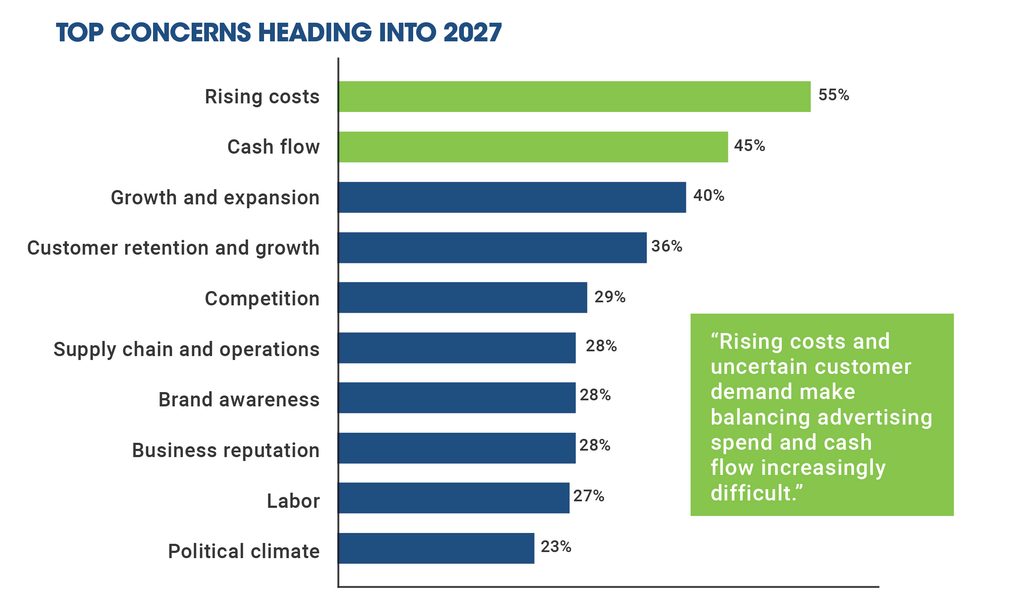
Cost is the pressure point in our data too. Rising costs lead every other concern, with cash flow close behind at 45%.
Owners aren’t waiting to react. Only 11.3% have made no marketing changes in response to the economy. The most common moves are offering lower price points (49.0%), promoting across new marketing channels (44.7%) and adding discounts or incentives (40.3%). Another 27.2% are delaying payment or offering financing.
“Rising costs and uncertain customer demand make balancing advertising spend and cash flow increasingly difficult.”
What stops local businesses from advertising more?
Price is the most-cited obstacle at 43.2%, but it isn’t the whole story. Four of the top five barriers are about execution: who to reach, what to offer, how to measure results and what to say.
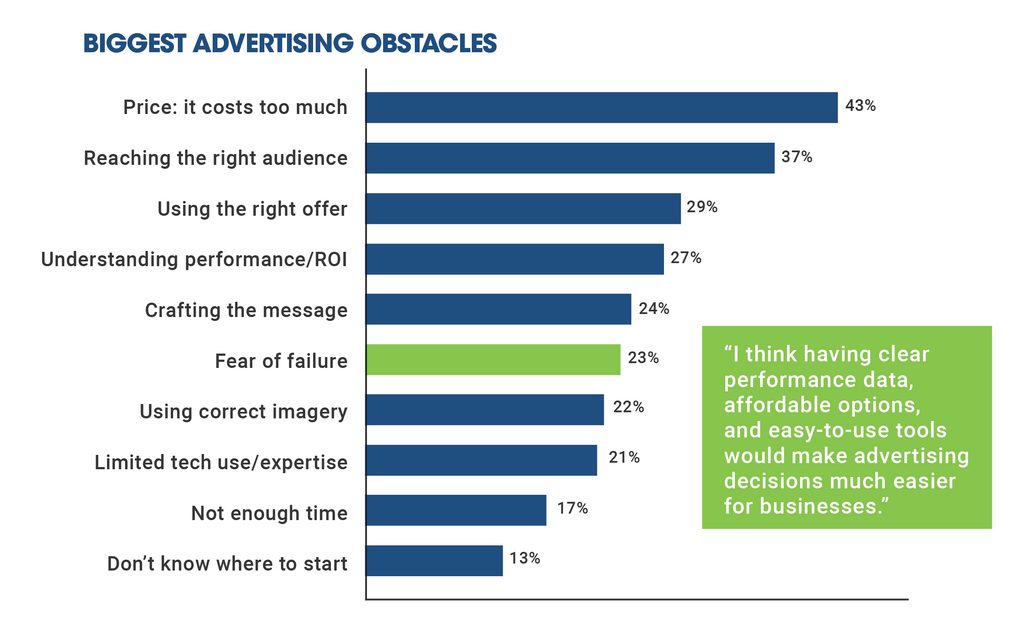
Two findings stand out. First, 23.3% of owners name fear of failure as an obstacle, more than the 16.7% who cite a lack of time. When the budget is tight, a campaign that flops costs more than money. It costs confidence in advertising itself. Second, 12.6% simply don’t know where to start.
The same practicality shows up in how owners pick channels. Cost leads at 47.3%, but past experience (42.0%), ease of use (40.9%), word of mouth (40.7%) and reviews (40.7%) carry nearly as much weight. Only 19.8% say they follow what their competitors do. Owners choose what is affordable, proven and simple to run.
“I think having clear performance data, affordable options, and easy-to-use tools would make advertising decisions much easier for businesses.”
Which advertising channels are local businesses using?
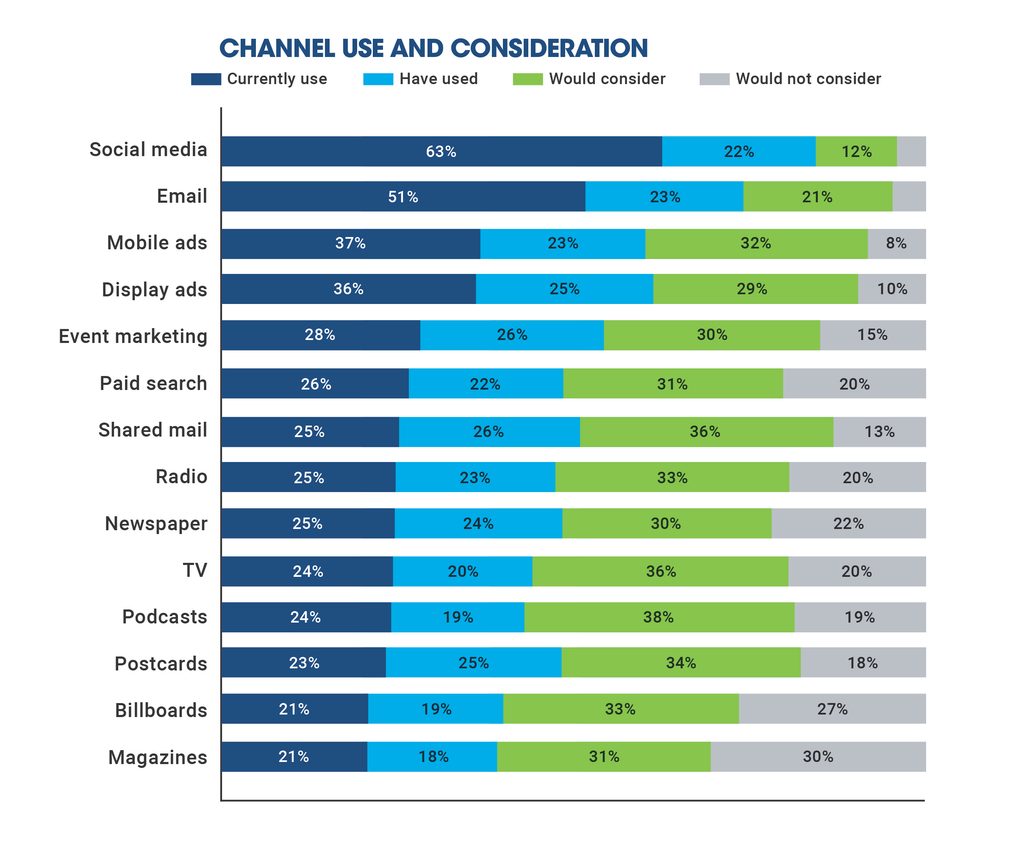
Social media is the default. 62.6% of owners use it today, and email follows at 51.4%. No other channel reaches 40% current use.
The more revealing number is consideration. Podcasts (37.9%), TV (36.4%), shared mail (35.6%) and postcards (33.7%) all have more owners willing to try them than currently using them. That is a large pool of owners who are open to a channel but haven’t been given a reason to start.
Budgets are modest. More than a quarter of owners (27.8%) spend under $10,000 a year on advertising, and about two-thirds spend under $50,000. On average, social takes the largest share of spend (21.7%), followed by digital (18.4%), event marketing (15.7%), direct mail (14.4%) and radio (13.5%).
Where are local advertising budgets going next year?
Mostly to social and digital. Half of owners (50.6%) plan to increase social spend and 45.3% plan to increase digital. Direct mail is the channel owners are most likely to hold steady, with 44.2% planning no change.
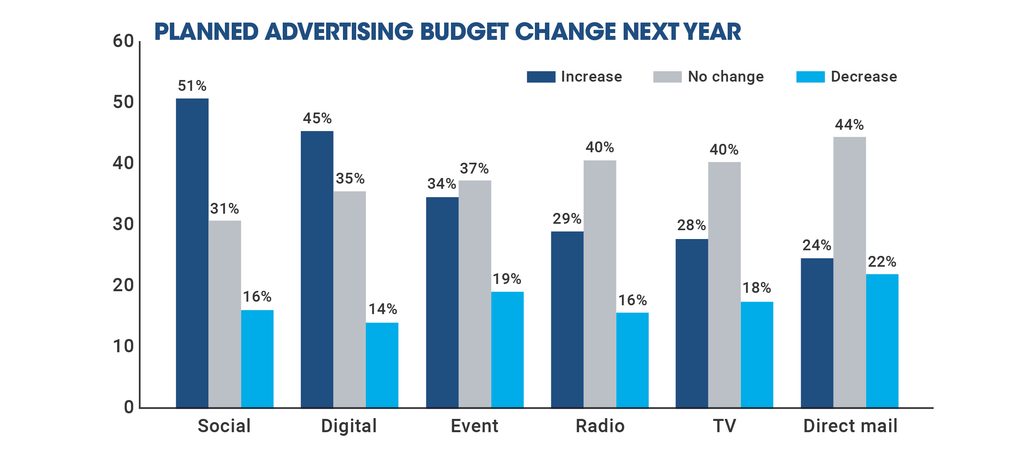
Timing matters as much as allocation. Q2 (April through June) is the heaviest spending quarter for 27.6% of owners, while Q4 is the peak for only 14.8%. And the most common budgeting approach (36.6%) is adjusting spend as results come in. Channels that can show what they produced, quickly, are the ones that keep their share.
How are local businesses responding to higher postage costs?
By getting more precise, not by walking away. Among the 464 respondents with mail experience, 43.3% mail monthly or quarterly and 27.4% mail weekly or more. Most (36.0%) have used mail for three to five years. These are committed mailers.
Postage is still a real cost. USPS raised mailing services prices about 4.8% on July 12, 2026, including a Forever stamp increase from 78 to 82 cents and a postcard increase from 61 to 65 cents. The impact depended heavily on format. According to the News/Media Alliance, Marketing Mail increases ranged from 1.36% for high-density and saturation flats to 7.219% for carrier route. Shared mail programs that ship at saturation rates absorbed far less of the increase than solo mailers did.
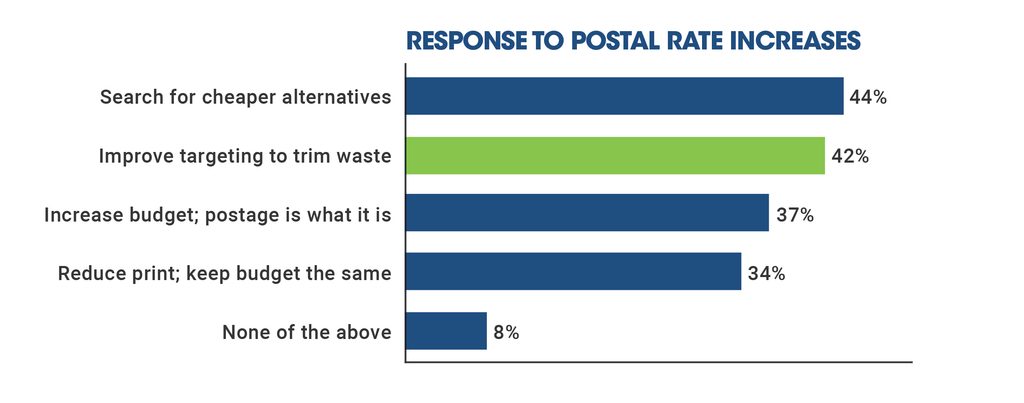
Owners are split on the response, but the direction is clear. Improving targeting to trim waste (42.2%) nearly ties searching for cheaper alternatives (44.0%), and more than a third (36.6%) will raise their mail budget because the channel works for them. That precision mindset goes beyond mail: 54.5% of all owners prefer targeting specific audiences or households over reaching as many homes as possible (44.9%).
The case for staying in mail rests on attention and memory. In a neuromarketing study by the USPS Office of Inspector General and Temple University, physical ads outperformed digital ads on ad recognition, brand recall and memory of specific ad details, among both younger and older participants. The study was small (60 participants), so it supports mail’s memorability rather than proving response rates, but it helps explain why so many mailers stick with the channel.
Why does direct mail get so little credit for leads?
Because the last click gets the credit. Owners measure success in customers and sales, not clicks. The top success metrics are new customers (39.1%) and increased sales (37.5%), followed by website traffic (29.4%) and ROI (28.0%). Click-through rate ranks last among named metrics at 16.0%.
Data matters to them, too. Most owners call data or modeling in marketing extremely important (43.4%) or somewhat important (39.7%), only 15.4% use no CRM at all, and 60.5% run their digital programs in house rather than through an agency (30.7%).
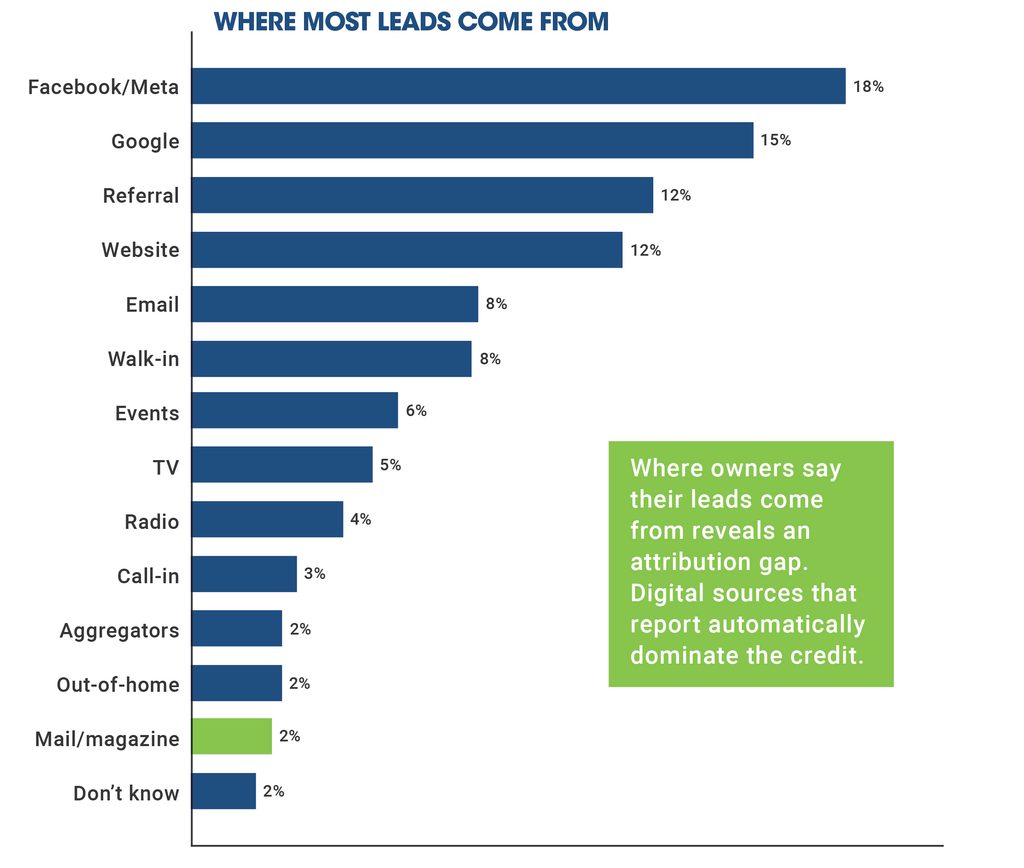
Yet when owners name their top lead source, only 2.3% say mail or magazines, even though roughly a quarter currently use shared mail or postcards and many mail every month. That gap has a simple explanation. A mailer often sends a customer to search, visit a website or walk in, and that final step is what gets recorded. Digital platforms report automatically. Paper doesn’t.
Closing the gap is mostly a matter of setup. Owners who add unique promo codes, QR codes or dedicated phone numbers to offline pieces get a truer picture of what each channel contributes.
Acquisition costs vary widely. The most common actual cost is $51 to $100 per customer (19.6%), followed by $101 to $250 (16.3%). Another 7.6% have never calculated it, which makes judging ROI on any channel difficult.
What do local businesses want from an advertising partner?
Reliability first. Nearly half of owners (49.6%) name it as what they look for in a partner, ahead of customer service (41.8%) and reasonable cost (39.7%).
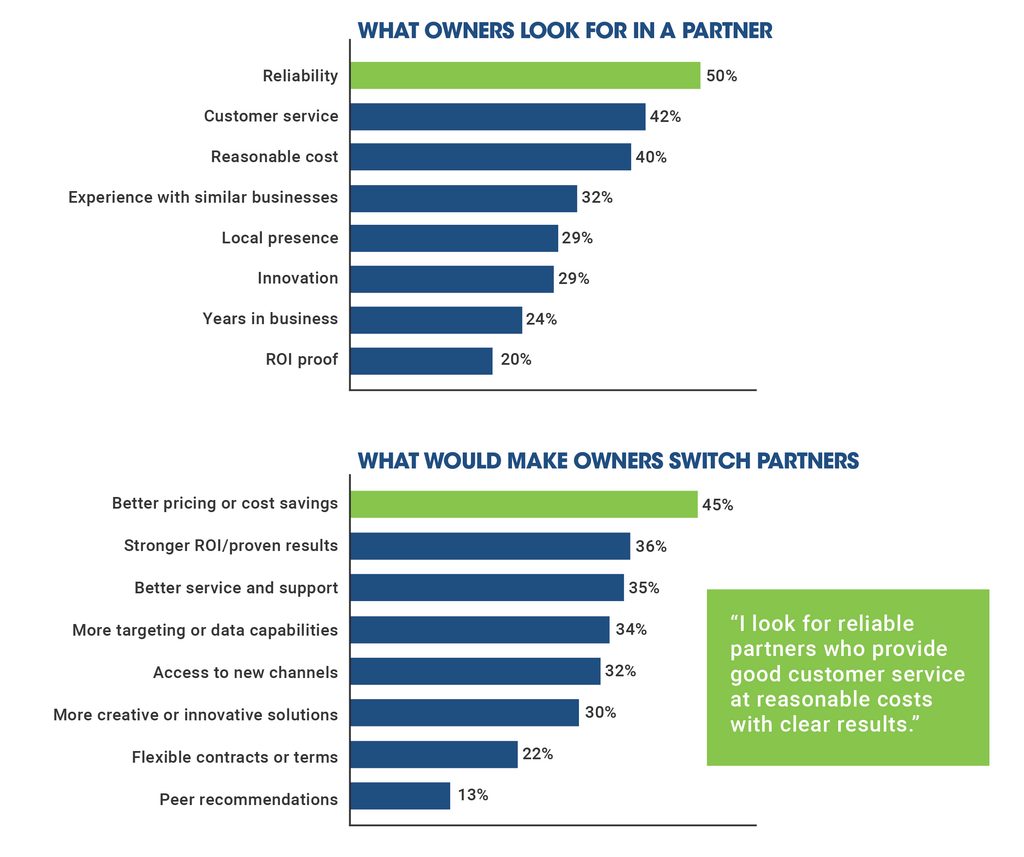
Price moves to the top only when owners think about leaving. 44.9% would switch partners for better pricing or cost savings. The next triggers are stronger ROI or proven results (36.2%), better service and support (35.4%) and more targeting or data capabilities (33.5%). Owners want a partner who can show what worked, not just report how many people saw an ad.
Consistency matters as well. 61.5% of owners say consistent advertising across mail, digital and social is very important because it builds brand recognition.
“I look for reliable partners who provide good customer service at reasonable costs with clear results.”
5 Advertising Moves for Local Businesses in 2027
The data points to five practical steps for owners planning next year’s advertising.
- Protect what works, then test one new channel. Keep social and email as the base, since most owners already rely on them. The 30%-plus consideration numbers for mail, TV and podcasts are a signal to test one new channel with a set budget and timeline.
- Target first, then scale. With postage up and budgets tight, spend on the households most likely to buy. Most owners already prefer targeting (54.5%), and 42.2% of mailers plan to sharpen it. Shared mail at saturation rates is one way to reach dense local areas at a lower cost per home.
- Lead with an offer, and test it. Eight in ten owners (80.7%) already include an incentive in their advertising, yet 28.6% struggle to choose the right one. Run two offers against each other to the same audience and keep the winner.
- Make every channel measurable. Add unique codes, QR codes or tracked phone numbers to offline pieces, and calculate cost per acquisition for each channel. Without tracking, mail gets credit from just 2.3% of owners, which says more about measurement than about results.
- Plan for Q2 and adjust as you go. Q2 is the heaviest spending quarter for 27.6% of owners. Book core campaigns early, then shift spend toward what performs, as 36.6% of owners already do.
Make Your 2027 Advertising Budget Work Harder
Owners told us what they need: a reliable partner, targeting that cuts waste and results measured in customers and sales. Valpak helps local businesses reach the right households with offers built to be tracked, so you can see what your advertising is actually bringing in.
Frequently Asked Questions
What are the biggest local business advertising trends for 2027?
Owners are optimistic about the economy but focused on cost, so they are spending more selectively. Social (50.6%) and digital (45.3%) lead planned budget increases, 54.5% prefer targeted audiences over maximum reach, and owners judge advertising by new customers and sales rather than clicks, according to Valpak’s survey of 514 owners.
How much do local businesses spend on advertising?
Most local advertising budgets are modest. In Valpak’s 2027 survey, 27.8% of owners spend under $10,000 a year on advertising and about two-thirds spend under $50,000. Social media takes the largest average share of spend (21.7%), followed by digital (18.4%), event marketing (15.7%) and direct mail (14.4%).
What is the biggest barrier to advertising for small businesses?
Price is the most-cited barrier, named by 43.2% of owners. But most of the top obstacles are about strategy: reaching the right audience (37.4%), choosing the right offer (28.6%), understanding ROI (27.4%) and crafting the message. Nearly one in four owners (23.3%) also name fear of failure.
Is direct mail still worth it for local businesses after the 2026 postage increase?
Many owners think so. Among businesses with mail experience, 36.6% plan to raise their budget because mail works for them, and 42.2% plan to improve targeting to cut waste. Shared mail sent at saturation rates also saw a much smaller 2026 increase (1.36% for high-density and saturation flats) than solo formats.
How much did USPS postage go up in 2026?
USPS raised mailing services prices about 4.8% on July 12, 2026. The Forever stamp rose from 78 to 82 cents and postcards from 61 to 65 cents. Marketing Mail increases ranged from 1.36% for high-density and saturation flats to 7.219% for carrier route, according to the News/Media Alliance.
How can a local business track results from direct mail?
Add a trackable element to every piece: a unique promo code, a QR code or a dedicated phone number. Then calculate cost per acquisition for each channel. Mail often drives customers to search or walk in, so without tracking, the last digital touchpoint gets the credit.
What do small business owners look for in an advertising partner?
Reliability tops the list at 49.6%, followed by customer service (41.8%) and reasonable cost (39.7%). Owners would most likely switch partners for better pricing (44.9%), stronger ROI or proven results (36.2%), better service (35.4%) or more targeting and data capabilities (33.5%).
About the research
The 2027 State of Local Business Advertising survey collected 514 complete responses from U.S. business owners and advertising decision-makers. Most respondents (81.7%) are solely responsible for their business’s advertising decisions; the rest share that role with one or more people. Direct mail questions were answered by the 464 respondents with mail experience. Percentages on select-all questions add to more than 100%.
Additional sources
- NFIB, “Main Street Optimism Cools in August but Holds Above Long-Term Average,” Sept. 8, 2026
- USPS, “U.S. Postal Service Recommends New Prices for July,” April 9, 2026
- News/Media Alliance, “USPS Announces July Rate Increases,” April 10, 2026
- USPS Office of Inspector General, “Advertising Effectiveness and Age,” RARC-WP-19-001, Feb. 25, 2019