

AI is reshaping online advertising and search results, changing how consumers receive information, as well as how ads are created and perceived. As much as 50% of today’s Google search queries render AI summaries and, according to McKinsey, half of consumers polled are using AI to research before making a purchase. To ignore the advent and ubiquity of AI in advertising and search is akin to watching the hole in the top of a hot-air balloon grow and grow, and doing nothing to plug it as you stoically plummet into reality.
Intelligent companions/assistants in the form of helpful, almost sentient tools have become their own marketing channel. They produce thoughts and inspiration, engage in conversation, and offer reasons to buy this or shop there or try something new.
Now, while the ads are not paid ads in AI search results quite yet, they certainly will be soon. Target is one of the first reported retailers to test ads across ChatGPT’s free and GO tiers, which will reportedly cost the retail giant $60 per 1,000 views per ad placement.
Valpak partnered with PureSpectrum to survey business owners and consumers about the impact of AI on advertising and search – and what that shift means for the future of the ad landscape.
Key findings
AI is reshaping trust in advertising:
- 41% of business owners trust AI ad platforms to optimize campaigns in their best interest, signaling growing reliance on automated media decisions.
Data privacy remains a major consumer concern:
- 28% of consumers are very concerned about how AI uses personal data for advertising.
Customer acquisition costs are trending upward:
- 27% of business owners report higher costs to acquire customers since AI has become more common in advertising.
Transparency is now table stakes:
- 37% of consumers say it’s extremely important for brands to disclose when AI is used in advertising.
AI introduces new challenges for advertisers:
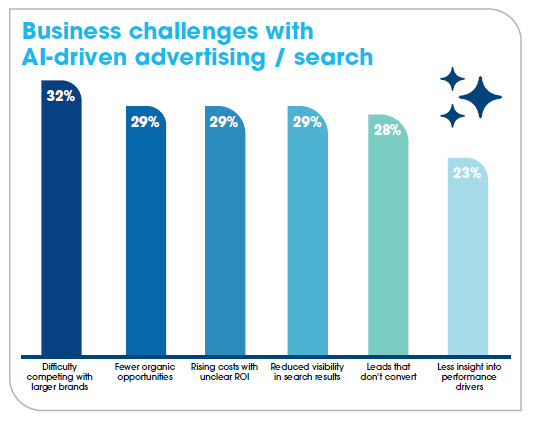
- 32% of business owners report difficulties with AI-driven advertising or search, including reduced visibility and competition with larger brands.
Despite concerns, confidence in AI performance is high:
- 71% of business owners believe AI is improving the effectiveness of their advertising somewhat or not.
What AI means for marketers (plain English version)
AI is changing where discovery happens and how decisions get made. More consumer journeys are starting – and ending – inside AI-powered experiences that summarize options, recommend brands, and answer questions without requiring a click. That shift reduces visibility for brands that rely heavily on traditional paid and organic search, while increasing pressure on performance channels as competition intensifies over fewer high-intent moments
- 60% of searches now end without a click (The 60% Problem).
- 1.08% of site traffic comes from AI referrals, showing AI as a discovery layer more than a click generator.
- 43% of consumers trust information from AI chatbots; that rises to 68% among regular AI users
AI answers are often ‘good enough.’ For marketers, this creates a double bind: Fewer opportunities to intercept demand as AI answers questions before users ever see ads or listings and higher acquisition costs as brands fight harder for a shrinking pool of conversion-ready queries.
The result: brands need channels that don’t depend on algorithms they can’t see, predict, or influence – and that still create demand earlier in the funnel.
The local visibility risk for SMBS
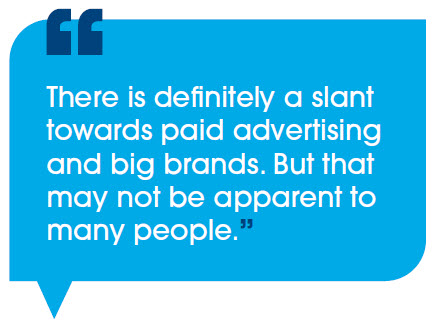
AI-driven search and recommendation engines are increasingly acting as gatekeepers between consumers and local businesses. While 40% of business owners believe AI summaries improve exposure, others report reduced visibility and difficulty competing with larger brands with deeper budgets and stronger digital footprints.
This new dynamic disproportionately impacts small and mid-sized businesses because:
- Larger brands are more likely to appear in AI-generated answers due to volume, reviews, and content scale.
- Local businesses have less control over how AI systems summarize or surface their offerings.
- Ranking logic is opaque, making optimization unpredictable and volatile.
In short: AI flattens nuance. Local differentiation gets lost.
Why trust + transparency now drive performance
While controlling and regulating new technologies has historically been as difficult as herding goldfish, consumer reactions, good or bad, can quickly mount and seriously affect businesses. It often falls to brands to make it clear to existing and potential customers when AI is being used in their ads. 94% of consumers said this transparency is important.
This creates a new brand expectation:
- Trust isn’t assumed – it’s earned through clarity, disclosure, and relevance.
- Perceived manipulation backfires – especially when AI is involved in targeting or personalization.
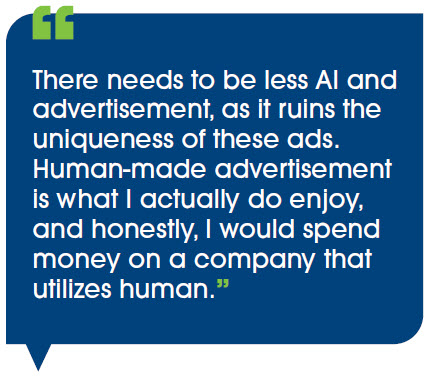
- Human oversight still matters – consumers respond better when brands signal that people, not just machines, are shaping their messaging.
When asked how much they trust personalized advertising powered by AI, 35% of consumers weren’t sure. Brands that balance AI efficiency with human authenticity will outperform those that automate without guardrails.
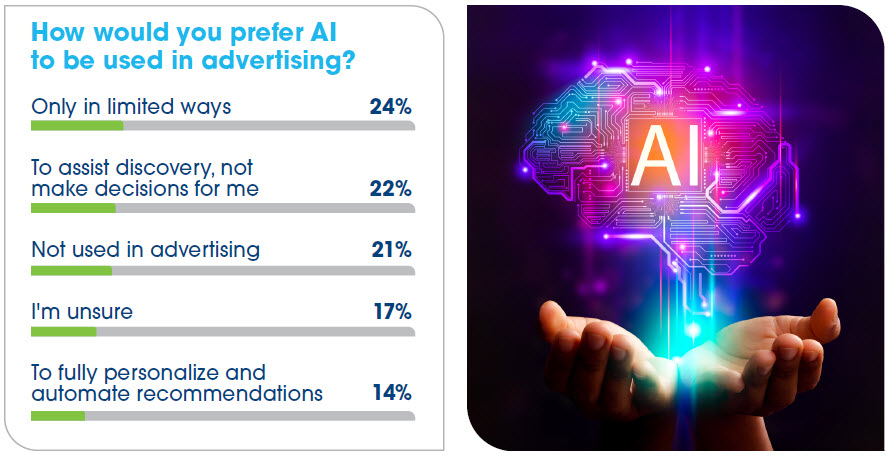
Looking ahead, when asked how they would prefer AI to be used in advertising, 24% said only in limited ways,
while 21% do not want AI used in advertising at all. Dare to dream, that ship has already sailed.
The channel diversification imperative
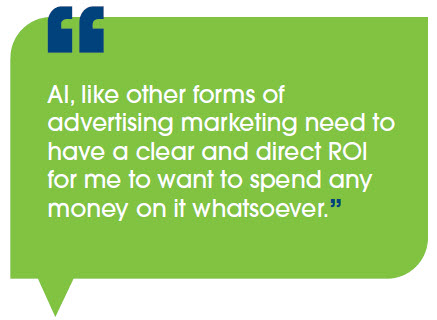
As AI reduces click-through from search and compresses the funnel, brands that rely too heavily on SEM or social performance marketing face rising costs, shrinking returns, and unpredictable volatility.
Smart marketers are already diversifying:
- Investing in demand creation, not just demand capture
- Rebalancing toward channels that create brand memory and physical presence
- Using performance channels more surgically, not as the sole growth engine
This is not about abandoning digital – it’s about building a more resilient media mix in a world where AI increasingly controls discovery.
Why direct mail gains strategic value in an AI world
As digital environments become more crowded, automated, and filtered through AI layers, physical media stands out precisely because it is unfiltered, human-visible, and algorithm-proof.
Direct mail offers advantages AI-driven channels can’t replicate:
- Guaranteed visibility (it gets into hands, not feeds)
- Zero algorithm risk (no ranking, bidding wars, or opaque placement logic)
- Stronger memory encoding (physical touchpoints create higher recall)
- Earlier funnel impact (drives awareness before AI search even begins)
In an era of shrinking clicks and rising CPCs, direct mail becomes a stability layer in the growth mix.
Predictable results in an unpredictable market
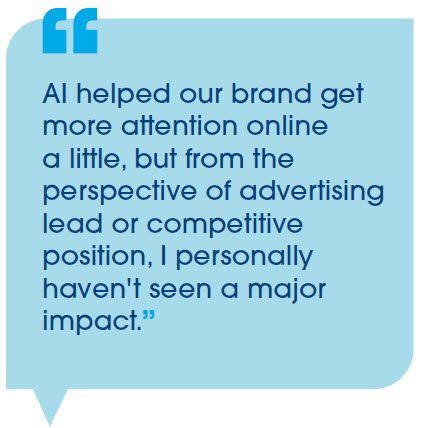
The shift to AI-powered search and zero-click behavior represents perhaps the most significant disruption to search marketing since search engines first displaced directories in the 1990s. For businesses relying heavily on SEM, the risk is real: rising costs, fewer leads and declining ROI. Moreover, channel diversification is critical in this new era of AI-driven uncertainty.
Valpak’s model is inherently insulated from the volatility of AI-driven search algorithms – a stable, proven way to reach homeowners locally – regardless of what happens in AI search. For businesses that operate on tight margins and rely on a predictable flow of local leads, investing in Valpak now may not just be a good alternative, but a pragmatic necessity. Valpak Chief Sales Officer Jay Loeffler shares, “Valpak has built over 50+ years of consumer trust and we allow brands to use our equity to develop and deepen relationships with consumers. While cost per metrics are rising in digital, we are seeing a renaissance of performance in direct mail with an average ROAS of 6:1.”