
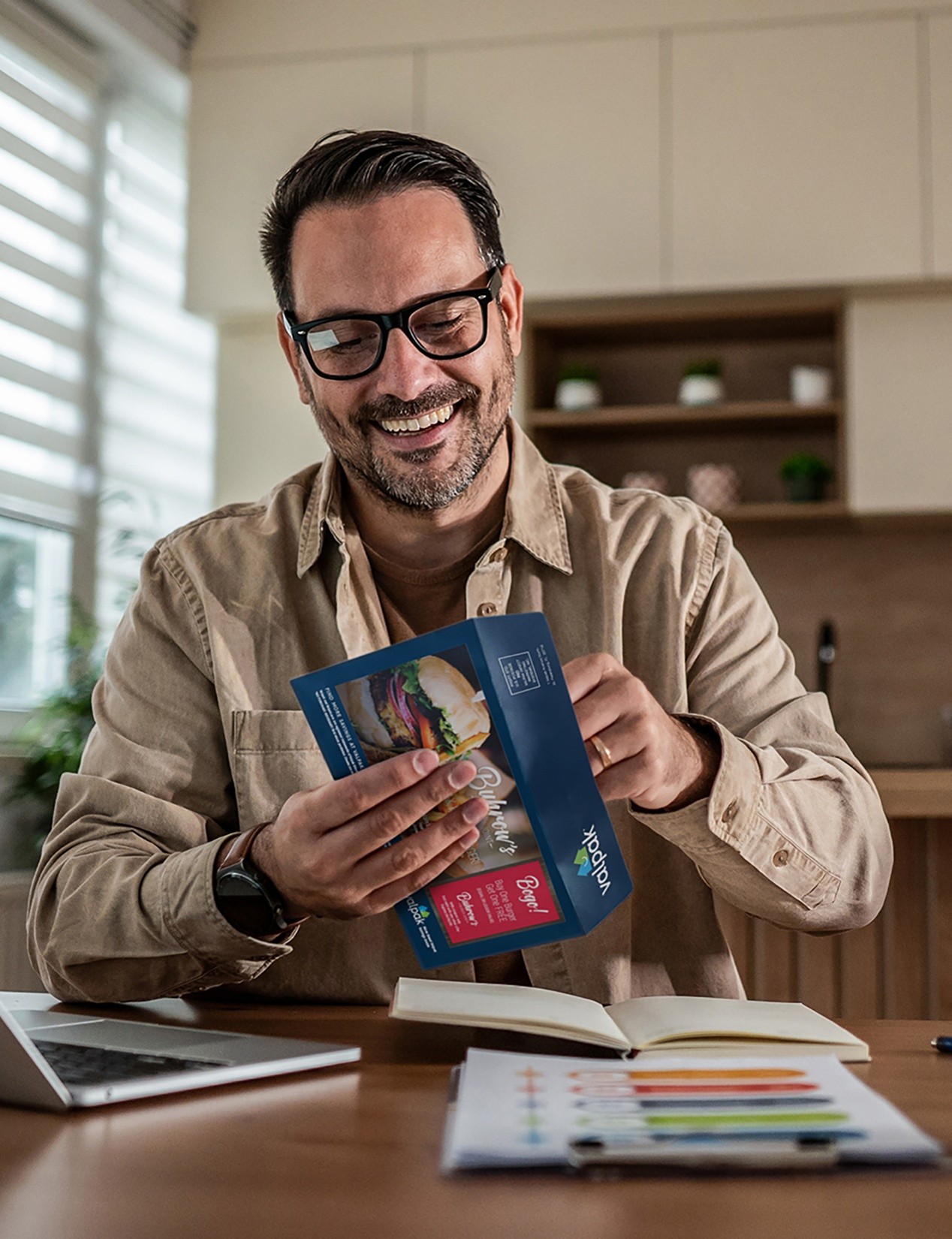
Nobody wonders what’s inside a utility bill. But hand someone an envelope that doesn’t give away its contents, and the reaction changes. They turn it over. They look for a clue. Usually, they open it.
That small moment is the subject of this post. In The E-commerce Halo Effect, 78% of U.S. adults said they pay close attention to their mail because they’re always on the lookout for packages. The report also made a narrower point: that extra attention isn’t spread evenly. It concentrates on mail that echoes a package, the kind that makes people wonder what’s inside.
Why would wondering matter so much? Because to the brain, curiosity isn’t a passing mood. It’s a reward signal, and researchers have spent three decades measuring what it does to attention and memory.
What is the curiosity gap?
The curiosity gap is the discomfort people feel when they notice something they don’t know and want to. Carnegie Mellon economist and psychologist George Loewenstein formalized the idea in “The Psychology of Curiosity”, a 1994 paper in Psychological Bulletin. He described curiosity as a kind of deprivation triggered by a perceived gap in knowledge, one people are motivated to close.
Two details from his work matter for mail. First, curiosity needs a starting point. People have to know a little before they want to know more. Second, the gap has to be the right size, as Nautilus summarized it. Too big and people disengage. Too small and there’s nothing left to wonder about.
An envelope with a recognizable brand, a local return address, or a hint of savings hits that middle ground. The reader knows roughly what it is. They don’t know exactly what’s inside. That’s the gap.
Why does a sealed envelope feel like a package?
A package and an envelope share one trait: you can’t see what’s inside until you open it. Dr. George S. Everly, Jr., the psychologist who reviewed the Halo Effect findings, connects that uncertainty to variable reward. Rewards that arrive unpredictably drive more persistent behavior than rewards people can predict. In the report, he compares it to a slot machine. Mail that makes you wonder is less likely to be tossed unopened, because you can’t be sure you won’t miss something.
Neuroscience backs the reward part literally. In a 2014 study published in Neuron, UC Davis researchers Matthias Gruber, Bernard Gelman, and Charan Ranganath scanned people’s brains while they waited to learn trivia answers. High curiosity increased activity in the midbrain and nucleus accumbens, regions tied to dopamine and reward.
Does curiosity make people remember more than what they were curious about?
Yes, and this is the finding that matters most for advertisers. In the same study, people in a state of high curiosity also remembered unrelated information better. The researchers flashed photos of faces during the waiting period, then ran a surprise memory test. Faces seen while curious were remembered better, both immediately and a day later.
Ranganath put it plainly: curiosity puts the brain in a state where it’s more likely to learn and retain information, even information that isn’t especially interesting or important.
It’s a lab-scale parallel to the halo, not proof of it, but the pattern is the same. Curiosity about one thing raises retention for what’s nearby. At the mailbox, the thing people are curious about is the package. What’s nearby is everything else in the stack.
What happens in the brain when people handle physical mail?
Curiosity gets the envelope opened. What’s inside still has to land. Here, two of the most-cited neuromarketing studies on mail point the same direction.
The USPS Office of Inspector General worked with Temple University’s Center for Neural Decision Making to compare brain and body responses to physical and digital ads. Digital ads were processed faster. Physical ads held attention longer, produced a stronger emotional response, and were remembered better. They also lit up the ventral striatum, the brain region tied to how much people value and want a product.
In Canada, a study commissioned by Canada Post and run by neuromarketing firm True Impact found that direct mail took 21% less mental effort to understand than digital ads. Brand recall was 70% higher. Mail’s motivation score ran 20% above digital’s, and pieces that engaged extra senses scored higher still.
Taken together: curiosity opens the door, and the physical format helps the message stick once it’s through.
Why does curiosity at the mailbox matter more in the age of AI?
Because screens are running out of surprises. SEO firm Graphite has tracked the share of new web articles written mainly by AI since ChatGPT launched. Its latest analysis puts it at roughly half of everything new, a level that has held since early 2025.
When content is infinite and interchangeable, the information gap shrinks. Readers assume they already know what the next post, ad, or email will say, so there’s nothing to wonder about. Scrolling replaces opening.
The mailbox works the other way. It holds a handful of real objects, each one sealed until someone decides to look. The Halo Effect report calls this low-noise space “attention whitespace.” Curiosity research explains why that whitespace is valuable: a closed envelope is one of the few remaining formats where the reader genuinely doesn’t know what comes next.
How can local businesses use curiosity in their direct mail?
The research suggests a few practical moves.
- Show enough, not everything. Loewenstein found curiosity needs a starting point. A recognizable local brand or a hint of savings on the outside sets up the gap. The full offer belongs inside.
- Look like something worth opening. The halo favors mail that shares a package’s traits: sealed, clearly addressed, with contents you can’t see yet.
- Pay off the open. Loewenstein also noted that curiosity tends to disappoint once it’s satisfied. A strong, specific offer keeps the next envelope from getting tossed.
- Be inside the moment. Gruber’s team found that material encountered during a curious state is remembered better. Ads that arrive in the envelope people are already curious about get the benefit.
- Use more than one sense. In the Canada Post study, sensory direct mail scored 30% higher on motivation than digital media.
A shared mail envelope like the Valpak envelope is built on the same logic. It’s sealed, it arrives at home, and it holds a mix of local offers the household can’t predict until it’s opened.
Want the backstory on why the mailbox earned this attention in the first place? Start with The E-commerce Halo Effect, then read Dr. Everly’s take on how the mailbox went from a source of stress to a source of reward.
Frequently asked questions
Why do people open direct mail? Curiosity is a major driver. When a piece of mail hints at what’s inside without revealing it, it creates an information gap the reader wants to close. Research links that state to the brain’s dopamine-based reward system.
What is the curiosity gap in marketing? The curiosity gap is the space between what a person knows and what they want to know. Psychologist George Loewenstein described it in 1994. Marketers use it by offering enough information to spark interest while holding back the payoff.
Does curiosity improve ad recall? Research suggests it can. A 2014 UC Davis study in Neuron found people in a curious state remembered both the information they sought and unrelated information they saw at the same time.
Is direct mail more memorable than digital ads? Neuromarketing studies point that way. A Canada Post study found 70% higher brand recall for direct mail than digital ads. A USPS OIG and Temple University study found physical ads were remembered better and triggered stronger emotional responses.
What is the E-commerce Halo Effect? It’s the finding that package anticipation raises attention at the mailbox and doorstep, and some of that attention spills onto nearby mail. A 2026 report commissioned by Valpak Clipp found 4 in 5 U.S. adults pay closer attention to their mail because they’re watching for packages.
Why does physical mail matter more as AI content grows? Roughly half of new web articles are now primarily AI-generated, according to Graphite. As digital content becomes more abundant and predictable, a sealed physical envelope stands out as one of the few formats that still holds a genuine surprise.
Sources
- Bright Trail Customer Development, The E-commerce Halo Effect, 2026. Survey of 1,800 U.S. adults, fielded Dec. 2024 to Jan. 2025.
- Everly, G. S., Jr. “The Halo Effect: Visits to the Mailbox Were Once Associated With Stress—Times Have Changed.” CSHR International Journal, Vol. 8, No. 1, September 2026.
- Loewenstein, G. “The Psychology of Curiosity: A Review and Reinterpretation.” Psychological Bulletin, 1994.
- Gruber, M. J., Gelman, B. D., & Ranganath, C. “States of Curiosity Modulate Hippocampus-Dependent Learning via the Dopaminergic Circuit.” Neuron, 84(2), 2014.
- USPS Office of Inspector General and Temple University. Enhancing the Value of Mail: The Human Response, RARC-WP-15-012, 2015.
- Canada Post and True Impact Marketing. A Bias for Action, 2015.
- Graphite. AI Now Writes as Many Online Articles as Humans, 2026.
- Nautilus. Curiosity Depends on What You Already Know.
- Neuroscience News. How Curiosity Changes the Brain to Enhance Learning, 2014.